Melt or Miss: The Real Science Behind Why Your Burger Cheese Actually Matters
Ask any serious burger person what separates a forgettable patty from one that haunts your memory, and they'll eventually land on cheese. Not because cheese is flashy — it isn't — but because it's quietly responsible for a massive portion of what you actually taste, feel, and remember about a burger. And yet, most of us have never stopped to think about why some cheese works and some doesn't, beyond a vague sense that it either melted right or it didn't.
That instinct, it turns out, is pointing directly at the science.
The Physics of the Melt
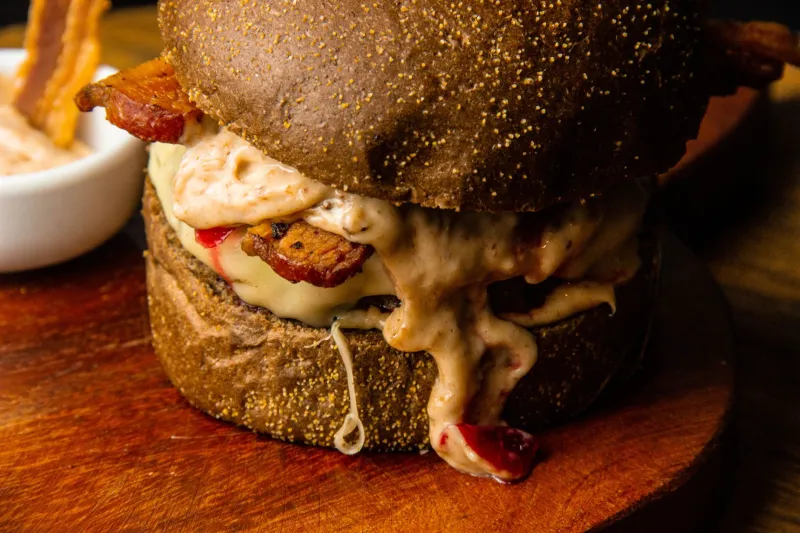
Cheese melts because of two things: water content and fat structure. When heat hits cheese, the fat begins to liquefy and the protein matrix — the stuff holding everything together — starts to loosen. Do it right, and you get that glossy, cohesive blanket that drapes over a patty like it belongs there. Do it wrong, and you get one of two disasters: a greasy, broken puddle that slides off the meat, or a rubbery, barely-softened slab that might as well be a cold tile.
American cheese — the processed kind, the stuff in the individual plastic wrappers — melts so consistently because it's specifically engineered to do so. Sodium citrate and other emulsifying salts keep the fat and protein from separating under heat. That's not a knock. That's actual food science working in your favor at a cookout. The melt is smooth, predictable, and forgiving even if your grill runs a little hot.
Aged cheddar, on the other hand, has a much lower moisture content and a tighter protein structure. It can melt beautifully under the right conditions — low, even heat, given enough time — but push it too fast or too hot and it breaks. The fat separates, the solids clump, and you end up with an oily mess that doesn't cling to the beef the way it should.
The Flavor Equation Nobody Wants to Admit
Here's where it gets uncomfortable for the cheese snobs among us: in a blind taste test, most people cannot reliably distinguish between properly melted premium aged cheddar and a well-applied slice of American cheese on a burger. This isn't a hypothetical. Burger researchers and food scientists have run variations of this experiment, and the results consistently show that context collapses the difference.
Why? Because the dominant flavors in a properly constructed burger — the Maillard crust on the beef, the fat rendering into the bun, the salt — are loud. Cheese, unless it's something aggressively funky like a blue or a washed-rind variety, is playing a supporting role. It adds creaminess, a bit of salt, and a fatty richness that binds the whole bite together. When you've got smoke, char, and beefy umami doing the heavy lifting, the nuance of a $20-per-pound cheddar gets buried.
That doesn't mean expensive cheese has no place on a burger. It means you need to be strategic about it.
Which Cheeses Are Actually Doing Work
Professional kitchens have figured this out through repetition. The cheeses that earn consistent real estate on serious burger menus aren't always the prestigious ones — they're the ones that behave.
American cheese remains the undisputed melt champion. Its emulsified structure means it performs at almost any temperature, and its mild, creamy saltiness genuinely complements beef without competing with it. There's a reason it's the default at diners from Albuquerque to Augusta.
Gruyère is the dark horse of the upscale burger world. It melts with a nutty, slightly sweet richness that layers well with caramelized onions and doesn't fight the beef. It requires more attention — lower heat, more time — but the payoff is a more complex bite without overwhelming the patty.
Pepper jack has carved out serious territory in the Southwest, where heat is expected and appreciated. The cheese melts decently and delivers a spice hit that builds with each bite, making it a natural partner for chiles, avocado, and smoky sauces.
Muenster is criminally underused. It melts almost as reliably as American, has a buttery, slightly tangy flavor, and doesn't get enough attention outside of certain Midwest diners where it's been a quiet staple for decades.
Blue cheese, crumbled or sliced, is a different animal entirely. It doesn't really melt so much as it softens and intensifies. It's assertive, polarizing, and absolutely correct on the right burger — usually one with a bold, fatty patty that can hold its own against the funk.
Regional Loyalties Are Real and They're Delicious
America's regional burger culture has strong opinions about cheese, and those opinions are baked into local identity in ways that go beyond taste preference.
In the upper Midwest — Wisconsin especially — cheese isn't just a topping, it's a point of pride. Burgers in Green Bay and Milwaukee often come loaded with local cheese curds, aged cheddars, and brick cheese that you simply won't find at a chain. These aren't novelty choices; they're the product of a dairy culture that's been producing world-class cheese for over a century.
In the South, American and pimento cheese split the loyalty. Pimento cheese burgers, particularly in the Carolinas and Georgia, have become something of a regional institution — the spread melts unevenly but delivers a creamy, tangy, slightly smoky character that's completely distinct from anything else in the burger world.
On the coasts, the trend has leaned toward artisan and imported varieties — comté, manchego, brie — as restaurants try to justify premium pricing. Some of these work. Many don't. A brie burger sounds luxurious until the cheese runs off the patty and disappears into the bun before you get the second bite.
What the Professionals Actually Do
Talk to line cooks at serious burger spots and a consistent picture emerges. Most keep American cheese as their baseline and build from there depending on the burger's flavor profile. They steam-melt whenever possible — a small amount of water in the pan, a dome lid over the patty — because it distributes heat evenly and gives the cheese time to adhere rather than just soften.
They also think about cheese placement differently than home cooks do. Layering two thinner slices instead of one thick one gives more surface coverage and a more even melt. Applying cheese earlier in the cook, not at the very end, means it has time to actually integrate with the crust rather than just sitting on top of it.
And they're ruthless about matching cheese to the burger's other components. A heavily seasoned smash burger with raw onion and mustard doesn't need gruyère. A thick, loosely packed patty with mushrooms and caramelized onions probably does.
The Bottom Line
The brand name on your cheese matters less than what that cheese does once it hits heat. Melt behavior, fat content, flavor intensity, and regional context are the real variables. American cheese earned its place on the burger throne through performance, not prestige, and there's no shame in acknowledging that. But there's also real magic in knowing when to reach for something with more personality — and understanding exactly why it works when you do.