Thirty Burgers in Thirty Days: A Field Report From the Road
On the first of the month, I made a rule: one burger per day, thirty days, thirty different establishments, no repeats, no chains I could find at home. No skipping days. No doubling up. Just me, a rental car, and the single most reliable food object in America.
I thought I was writing about burgers. By week two, I realized I was writing about us.
Week One: The Defaults
The first seven days were the easy ones—the famous places, the ones on every list. A legendary smash burger counter in the Midwest where the line moved like a machine and nobody looked up from their tray. A drive-in in the Southwest where carhops still exist and the burger came in a paper sleeve, dripping through the bottom the way it has since 1958.
What struck me wasn't the food. It was the regularity of the people. At every one of these spots, the same scene: a guy in work boots, same time every day, ordering the same thing. The counter staff didn't ask. They just made it. Day one, I thought I was studying burgers. Really, I was studying ritual.
Week Two: The Gas Station Revelation
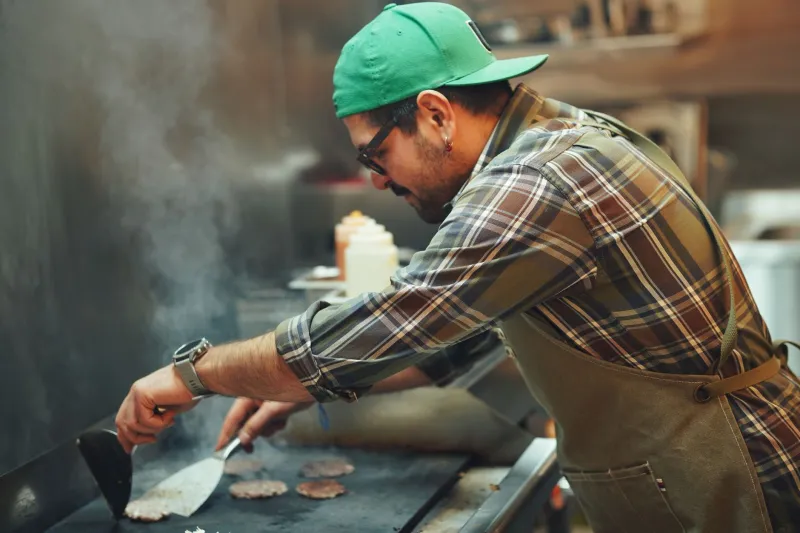
Day nine changed the trip. Somewhere on a two-lane highway in West Texas, I stopped for fuel and saw a hand-painted sign: HAMBURGERS. Inside a gas station convenience store, a woman named Doreen was pressing quarter-pound balls of beef flat on a griddle that had clearly never been fully cleaned since the Reagan administration.
It was one of the best burgers I've ever had. Thin, lacy-edged, on a toasted white bun, with pickles and onions and a slice of American cheese that melted into every crack. Cost less than the gas.
Here's what nobody tells you: the gas station burger is a real American institution, and it's dying quietly. Doreen told me she's the last one in the county still making them from scratch. "Everybody wants the roller food now," she said, jerking a thumb at the rotating hot dog machine. "Nobody wants to wait eight minutes."
Eight minutes. That's the whole business, right there. The burger asks for eight minutes of patience, and we're deciding, county by county, that we don't have it.
Week Three: The Fancy Ones
Days fifteen through twenty-one took me into the other end of the spectrum. A tasting-menu counter in Chicago where the burger course arrived with tweezered cornichons and a $28 price tag. A bistro in the Carolinas serving a dry-aged blend with a house pickle plate. A hotel bar in Denver charging $24 for a burger that was, honestly, very good but not three times better than Doreen's.
The fine-dining burger is a fascinating contradiction. It's a dish that signals luxury by referencing a food that signals comfort. Every chef I talked to acknowledged the tension. One put it perfectly: "The burger is the one thing on my menu that everyone has an opinion about. I can't hide behind technique. If it doesn't taste like the thing in their memory, plus a little more, I've failed."
That's the burden of the fancy burger: it's competing with a memory that costs $6.
Week Four: What the Burger Says
The last week blurred together in the best way. A tavern burger in Wisconsin served with a bratwurst-level amount of butter. A pastrami burger in Utah that made me question every regional food map I'd ever read. A Green Chile cheeseburger in New Mexico eaten on a plastic chair in the sun.
Somewhere around day twenty-six, the pattern became obvious. The burger is a mirror. In one town, it's a working lunch—fast, cheap, eaten standing up. In another, it's a Saturday destination, a reason to drive forty minutes. In another, it's a late-night argument-settler. Same beef, cheese, bread. Completely different meaning.
No other American food does this. Pizza comes close, but pizza is still an event almost everywhere. Sushi means one thing. Barbecue has become a pilgrimage food. The burger alone can be all of these things at once—background noise and centerpiece, $4 and $44, gas station and tasting menu.
Day Thirty
The final burger was, fittingly, the least planned. A roadside stand outside a small town, run by a high school kid and his mother, open maybe six months. He pressed the patty, she toasted the bun. It was imperfect. The cheese wasn't fully melted. It was wonderful.
Thirty burgers taught me three things. One: the distance between the best $5 burger and the best $30 burger is smaller than the industry wants you to believe. Two: the places that last aren't the ones with the best beef—they're the ones woven into the rhythms of the people who eat there. Three: eight minutes of patience might be the scarcest ingredient in America.
I'm taking the next month off. From burgers, anyway. Ask me about hot dogs.