Rare, Medium, or Charred to a Puck: The Great American Burger Doneness Debate
Rare, Medium, or Charred to a Puck: The Great American Burger Debate
There's a moment at almost every backyard cookout, every diner counter, and every upscale burger bar where someone has to ask the question: how do you want that cooked? And depending on who's answering, you'll get anything from a confident "medium-rare, please" to a slightly defensive "well-done, but not dry" to a blank stare that says I didn't know burgers came in settings.
Doneness is one of those burger topics that sounds simple until you actually dig into it. Then it gets messy — scientifically, culturally, and sometimes legally. So let's talk about all of it.
What Temperature Actually Does to a Burger Patty
Before we get into the opinions, here's what's physically happening inside that patty as it cooks.
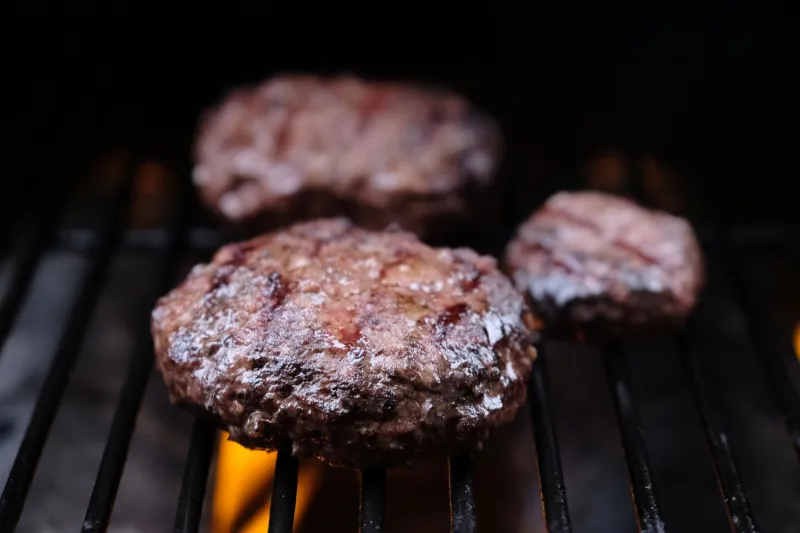
Ground beef is mostly water, fat, and protein. As internal temperature climbs, proteins tighten and squeeze out moisture. Fat begins rendering — liquefying and redistributing through the meat — which is a huge part of where burger flavor actually comes from. Hit around 130°F and you've got a juicy, pink center with fat still locked in. Push past 160°F and the proteins have contracted hard enough to force most of that moisture out, leaving you with a drier, denser result.
This is why burger enthusiasts get so worked up about doneness. It's not just aesthetics. Temperature is the single biggest variable controlling texture and juiciness in a finished patty. A well-marbled 80/20 grind cooked to medium-rare is a fundamentally different eating experience than the same patty cooked to 170°F — not worse necessarily, just different in ways that matter.
Fat percentage also changes the equation. Leaner grinds (90/10 or higher) have less fat to render, so they dry out faster and more noticeably at higher temps. If you're ordering well-done at a place using lean beef, you're stacking the odds against yourself.
The Safety Question Nobody Wants to Have at the Table
Here's where things get genuinely complicated. The USDA recommends cooking ground beef to an internal temperature of 160°F — full stop. That guidance exists for real reasons. Unlike a whole steak, where surface bacteria get destroyed by searing and the interior stays relatively sterile, ground beef mixes surface and interior together during grinding. Pathogens like E. coli O157:H7 can end up distributed throughout the patty, not just on the outside.
So when a restaurant serves you a medium-rare burger, they're technically operating outside federal food safety recommendations. Some states have specific regulations that require restaurants to either cook ground beef to 160°F or have customers sign a written acknowledgment that they're requesting undercooked meat. Others leave it more loosely regulated. The result is that the same order — "medium-rare burger, please" — might be totally routine at a chef-driven burger spot in New York City and completely off the menu at a diner in a state with stricter enforcement.
Some higher-end restaurants get around this by grinding their own beef in-house and using whole muscle cuts, which dramatically reduces the contamination risk. Others use a process called grinding-to-order. These approaches genuinely do change the safety calculus. But most burger joints aren't doing any of that, which means the medium-rare you're getting at a random fast-casual spot carries more risk than the same order at a place with tight sourcing and in-house grinding.
None of this makes medium-rare burgers universally dangerous. Millions of people eat them every year without incident. But it's worth understanding what you're actually choosing when you make that call.
Regional Attitudes Are All Over the Map
How America feels about burger doneness isn't uniform — not even close.
In major coastal cities, especially in the food-obsessive dining scenes of New York, Los Angeles, and San Francisco, medium-rare has become almost a default expectation at quality burger spots. Chefs who came up through fine dining brought steak sensibilities to the burger world, and a generation of food media coverage followed. Ordering well-done at certain spots in these cities can get you a look.
Move into the Midwest and the South and the vibe shifts. Well-done has deep roots here — partly tradition, partly practical (backyard grilling culture where the cook isn't checking temps with a thermometer), and partly genuine preference for the texture. In Texas, Oklahoma, and parts of the Great Plains, a burger that's cooked through is just... a burger. There's no apology required.
The smash burger movement, which has exploded nationally over the last decade, sidesteps the whole debate in an interesting way. Because smash patties are thin and cook on a flat-top at high heat, they're done almost by definition — there's not enough thickness to sustain a pink center. The Maillard reaction does its thing on the crust, and you get flavor from char and sear rather than from a pink, fatty interior. It's a different kind of burger satisfaction, and it's converted a lot of people who thought they wanted medium-rare but actually just wanted flavor.
The Well-Done Hate: Snobbery or Legitimate Critique?
Let's be honest about something: a lot of the contempt directed at well-done burger orders is food snobbery wearing the costume of culinary expertise.
Yes, cooking a burger to 170°F will result in a drier patty. Yes, you're sacrificing some juiciness. But plenty of people prefer that texture — the firmer bite, the more uniform color, the absence of what some folks find to be an off-putting soft center. That's not wrong. That's just a preference.
Where legitimate critique does land is in execution. A well-done burger that's been properly made — good fat percentage in the grind, not overworked, cooked with some care — can still be a great burger. The problem is that well-done is often used as cover for lazy cooking: pressing the patty down on the grill, cooking on too-low heat for too long, and delivering something that's dry because of technique failures rather than temperature alone.
Chefs who work high-volume burger programs will tell you that the worst outcomes they see aren't from well-done orders — they're from inconsistent cooking at every temperature. An unevenly cooked medium patty with a cold center and an overdone edge is worse than a properly executed well-done burger. Temperature is a preference. Execution is a skill.
Finding Your Own Doneness
If you've never really experimented, here's a simple framework. Next time you're somewhere with a quality burger program, try ordering medium instead of defaulting to well-done or rare. Medium — an internal temp around 140-145°F — hits a sweet spot that most people find approachable: some pink, plenty of juice, good texture without the soft, almost raw quality that medium-rare can have.
Pay attention to the grind too. Ask what fat percentage the restaurant uses. An 80/20 or 75/25 blend is going to stay juicier at higher temps than a leaner grind. And if you're cooking at home, invest in an instant-read thermometer. Guessing by feel is how you end up with patties that are grey outside and raw inside.
The best burger temperature is ultimately the one that makes you want to take another bite. The science gives you a map, the safety guidelines give you guardrails, and regional culture gives you context — but the plate in front of you is yours to call.
Just maybe stop giving people grief about how they order it.